18th Feb 2026
Spraying vertical surfaces demands control, consistency, and a solid understanding of how coatings behave under gravity. Whether you are applying high-build protective coatings in industrial environments or working on residential projects, runs and sags are among the most common and frustrating defects. Fortunately, with the right technique and setup, they are completely avoidable.
This guide covers the core principles every operator should follow to avoid runs and sags when spraying vertically: spray angle, distance, pressure settings, movement speed, and coating control. Although the focus here is on industrial spraying, the same fundamentals apply across all environments.
Why runs and sags happen
Runs and sags occur when too much material is applied before the coating can stabilise on the surface. Gravity pulls wet coatings downward, making vertical spraying more sensitive to errors in technique.
Contributing factors include:
- Excessive film build
- Incorrect spray angle
- Holding the gun too close
- Moving too slowly
- Overlapping too heavily
- Incorrect pressure or tip size
These issues become more noticeable on large steel structures, tanks, bridges, fabricated sections, and other industrial assets where thickness matters but must stay controlled.
1. Maintain the correct spray angle
A consistent spray angle ensures even distribution and reduces the risk of heavy build-up.
- Aim for 90 degrees: Hold the spray gun perpendicular to the surface. Angling the gun creates uneven coverage: too much material at the bottom of the fan and too little at the top, increasing the risk of runs.
- Keep your wrist straight: Avoid arcing your arm. Move your entire arm instead of flicking your wrist – this keeps the spray pattern uniform across the entire pass.
2. Control your distance from the surface
Distance plays a major role in how thick the coating lands.
- Ideal distance – 6-12 inches: For most industrial spray guns, this is the recommended range. Too close and the coating builds up too quickly; too far and the fan becomes dry and inconsistent.
- Keep distance consistent: Varying your distance creates uneven film build and localised sagging. Aim to keep the gun steady throughout each pass.
3. Select the right pressure and tip size
Correct spray pressure and tip selection help you achieve a smooth, drip-free finish.
- Pressure that’s too high: This can create overspray and dry spray, leading to rough texture. Operators may overcompensate by applying more material, which increases sag risk.
- Pressure that’s too low: This produces a heavy, uneven pattern that deposits excess material in one area.
- Choosing the correct tip: High-build industrial coatings often require larger tip sizes, but going too large increases the likelihood of sagging. Use the coating manufacturer’s technical data sheet as your guide. Operators should ensure tips are sized to match both material viscosity and spray system capability.
Need guidance choosing the correct tip or setup? Our team can help you match equipment to your coating system.
4. Manage your movement speed
Movement speed often separates skilled operators from inconsistent ones.
- Maintain a steady, deliberate pace: Too slow and the coating floods the surface. Too fast and it becomes patchy, encouraging operators to respray areas and unintentionally overload them.
- Overlap passes by 50%: This ensures even coverage without applying too much material in one go.
- Start and stop off the surface: Triggering the gun on the surface creates instant overloading, which is a common cause of runs.
5. Build the coating in thin, even layers
High-build coatings are common in industrial settings, but thickness must be controlled.
- Multiple thin coats: Two or three light passes are far safer than one heavy application.
- Flash-off times: Allow the coating to settle and firm up before applying the next layer. Industrial coatings often require specific flash-off periods to prevent sagging between passes.
6. Use proper lighting and inspection techniques
Runs and sags are easier to correct early.
- Use angled lighting: Positioning lights so they skim across the surface helps reveal early defects before the coating cures.
- Check your work frequently: Especially with large steel structures, storage tanks, or complex geometries where shadows can conceal developing runs.
7. Environmental conditions matter
Temperature and humidity influence coating flow.
- High temperatures: Coatings may dry too quickly at the surface while remaining wet underneath, making sags harder to spot.
- Low temperatures: Slower curing increases the chance of runs forming.
- Wind and airflow: Uneven airflow in spray booths or outdoor industrial environments can affect atomisation and overspray, impacting film build.
Working in a spray booth or spray room? Consistent airflow and controlled conditions make all the difference. If you need guidance on maintaining or upgrading your spray booth or room setup, our team can help ensure you’re getting the best results.
8. Equipment maintenance for a smooth finish
Poor equipment condition makes sag control more difficult.
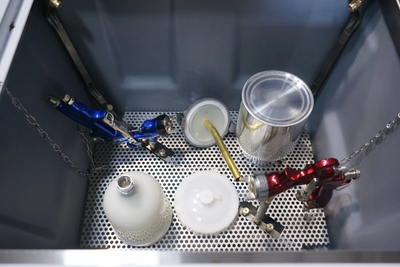
- Clean spray guns thoroughly after each use
- Replace worn tips and needles
- Check for inconsistent fan patterns
- Ensure hoses and filters are not clogged
For industrial operators, routine equipment checks should be part of daily practice to maintain a consistent, high-quality finish. Need your spray equipment checked or serviced? Our technicians provide full inspections and maintenance to keep your setup running safely and consistently. Get in touch to book a service.
Final thoughts
Avoiding runs and sags on vertical surfaces is a blend of technique, equipment setup, and attention to detail. Industrial environments demand precision, consistency, and an understanding of how coatings behave under pressure and gravity. Residential applications follow the same principles, but high-build industrial coatings make technique even more essential.
By applying the methods above – controlling angle, distance, speed, and equipment settings – operators can achieve smooth, professional finishes across any vertical surface.
If you’re reviewing your spray setup or looking to reduce defects on site, our technical team can offer guidance tailored to your application, just get in touch here.