4th Feb 2026
Blasting awkward angles, tight corners, and enclosed spaces can be one of the biggest challenges for operators. These areas often collect corrosion, coatings, and surface contaminants that standard nozzles struggle to reach. Without the right approach, operators risk inconsistent preparation, excessive equipment wear, and reduced finish quality.
Whether you’re working inside pipes, around complex structures, or along narrow recesses, careful planning and selecting the correct equipment make all the difference. Below, we explore practical techniques for blasting tricky areas and highlight specialist tools, including pipe blasting equipment, that support safe, thorough, and efficient surface preparation.
The challenge of tight spaces
Irregular geometries and restricted spaces disrupt the normal flow of abrasive, making it harder to achieve full and even coverage. Limited visibility and reduced manoeuvrability mean operators can’t always position the nozzle at the correct stand-off distance, leading to shadowing, missed areas, and inconsistent surface preparation.
These hard-to-reach sections can also trap abrasive and increase nozzle rebound, accelerating equipment wear and raising the risk of operator fatigue or accidental damage in confined spaces.
Because of these challenges, operators need a more considered approach. Using the right accessories or specialist tools helps maintain finish quality, improves safety, and reduces the likelihood of costly rework.
Practical tips for blasting in challenging areas
1. Choose the correct nozzle for precision
A nozzle suited for confined areas makes a significant difference. Short Venturi or straight-bore nozzles concentrate abrasive flow, giving operators more control in tight spots. For corners or recesses, specialist angle nozzles can redirect abrasive without forcing operators into unsafe positions.
Tip: Match the nozzle type to the geometry. Straight-bore for precision; angle nozzles for corners; long Venturi for open surfaces.
Take a look at our range of nozzles available here.
2. Control stand-off distance
Maintaining consistent stand-off distance is particularly important in tighter spaces. Too close, and the blast pattern narrows excessively. Too far, and the abrasive loses velocity.
When space restricts movement, operators should adjust pressure and nozzle type to maintain an effective pattern without excessive wear.
3. Adjust your blast pressure
High pressure isn’t always the solution. Lower pressure can improve accuracy and reduce rebound in confined areas, helping operators avoid over-blasting or roughening the surface beyond specification.
4. Improve visibility wherever possible
Shadowed areas, internal cavities, and complex structures often hide patches of unprepared surface. Using portable lighting or endoscopic inspection tools helps ensure full coverage.
5. Use specialist equipment for internal and inaccessible surfaces
Standard blasting tools struggle in pipelines, storage tanks, ducts, and narrow sections. Purpose-built pipe blasting equipment ensures a consistent finish, even where direct nozzle access is impossible.
Pipe blasting equipment: What it is and when to use it
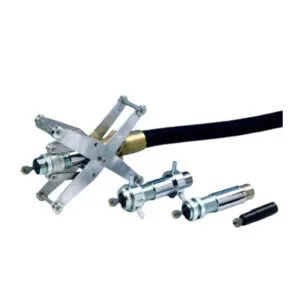
Internal surfaces, especially pipes, require equipment designed to blast from the inside out. These tools distribute abrasive in a controlled 360° pattern, removing corrosion, scale, and coatings while maintaining uniformity along the pipe wall.
When is pipe blasting equipment used?
Pipe blasting is ideal for:
- Pipeline maintenance and refurbishment
- Petrochemical and refinery applications
- Marine and offshore pipework
- Structural steel tubes and hollow sections
- Any situation where internal surface preparation is essential
This equipment ensures accuracy, reduces operator fatigue, and delivers consistent surface preparation inside diameters that conventional nozzles cannot reach.
Key equipment for blasting inside pipes
Airblast Eurospray offers several solutions designed to tackle internal surfaces effectively and safely. Below is an overview of the most used options.
CBO
The CBO system is designed for efficient internal cleaning of pipes ranging from 1¼” to 12” (32–305 mm) in diameter. It works by directing the air/abrasive mixture at a deflection tip, which spreads the abrasive into a wide 360° circular blast pattern inside the pipe. The tool connects in place of a standard nozzle and uses centring collars or a centring carriage to keep the blast head correctly positioned.
Why use it?
- Provides constant, uniform cleaning of the internal pipe surface
- Achieves high cleaning speed with minimal operator effort
- Reduces abrasive consumption due to efficient blast pattern
- Requires only one drive-through, ideal for long pipe runs
- Offers easy handling, minimal downtime, and adjustable settings
- Suitable for all abrasive types
How to select it:
Choose based on pipe diameter and length requirements. For deeper sections, an extender helps operators reach further without compromising blast quality.
Spinner blast – Rotating blast head
A spinner blast uses a rotating blast head to achieve an even 360° internal clean. The rotation ensures uniform impact speed and removes coatings or corrosion evenly across the entire pipe surface.
Key advantages:
- Consistent circumferential blasting
- Increased productivity in longer pipe sections
- Suitable for medium to large internal diameters
Selection considerations:
Match the spinner head size and rotation speed to the pipe diameter and required anchor profile.
Junior Hollo Blast
The Junior Hollo Blast system is ideal for smaller pipes or tubes with limited access. Its compact design allows abrasive to flow through a central body and disperse internally in restricted spaces.
Benefits:
- Perfect for narrow or small-diameter pipes
- Lightweight and easy to operate
- Allows effective blasting where larger heads won’t fit
How to choose the right model:
Base your choice on pipe diameter, required finish, and the abrasive media being used.
How to choose the right pipe blasting solution
When selecting internal blasting equipment, consider:
- Pipe diameter: Ensure the blast head is properly centred.
- Length of the section: Longer pipes may require extenders or guide systems.
- Media compatibility: Match equipment to the abrasive you’re using.
- Required surface profile: Spin speed and nozzle type influence profile depth.
- Accessibility: Choose equipment sized to navigate restrictions or bends.
If in doubt, always consult with our technical team for personalised recommendations, or you can take a look at our online brochure here.
Handheld solutions for awkward and localised areas
Not every hard-to-reach surface is suitable for pipe blasting equipment. Short sections, weld seams, flanges, brackets, and areas with restricted access often require more controlled, manual treatment.
In these cases, handheld surface preparation tools offer greater precision:
- Bristle blasters are commonly used in maintenance and repair work on steel structures such as pipelines, tanks, and metal beams. They allow operators to achieve a consistent surface profile, particularly around welds, edges, and localised corrosion, where traditional abrasive blasting may be impractical or too aggressive.
- Eductomatic vacuum blast machines are closed-circuit abrasive blast-cleaning systems designed for applications where dust and abrasive must be contained. Weighing approximately 3 kg, the hand-held unit is easy to manoeuvre in confined or awkward spaces. It features a swivelling blast head, with interchangeable heads available to suit different access requirements.
These tools are commonly used for:
- Touch-up work following automated blasting
- Preparation of complex geometries
- Treating areas where access, pipe length, or geometry limits internal blasting systems
Using handheld tools alongside pipe blasting equipment ensures all surfaces are properly prepared, even in the most challenging locations.
Final thoughts
Blasting in difficult angles and hard-to-reach areas demands a combination of correct technique and reliable, purpose-built tools. Whether you’re tackling tight corners, structural recesses, or internal pipework, planning your approach improves efficiency and ensures a consistent finish.
Airblast Eurospray provides a range of specialist blasting tools, including pipe cleaning systems and precision nozzles, designed to support operators working safely and effectively in challenging environments.