27th May 2026
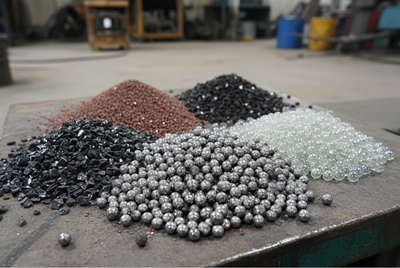
Selecting the right abrasive media is not just a technical choice – it directly affects cost control, surface finish quality, environmental impact and overall operational efficiency.
For contractors, procurement teams and facility managers, understanding the difference between recyclable and disposable abrasives is essential when planning blast rooms, recovery systems and abrasive supply strategies.
This guide provides a balanced comparison to support informed decision-making.
Understanding the two main types of abrasives
Broadly, abrasive media fall into two categories:
- Disposable: Designed for one-time use
- Recyclable: Recovered and reused multiple times
The right choice depends on your blasting environment, required surface profile, containment level and long-term cost objectives.
Disposable abrasives
Disposable abrasives are typically used once and then discarded. They are most common in open blasting environments where recovery systems are not practical.
The most common disposable abrasives are as follows:
- Produced from crushed recycled glass
- Available in extra fine to coarse grades
- Suitable for wood, brick, stone and softer substrates
- Cost-effective option
- Not suitable for wet blasting
- Available in extra fine to coarse grades
- Commonly used for steelwork and iron
- Aggressive and hard-wearing
- Not suitable for wet basting (comes out as sludge)
- Now silica-free
- Suitable for wood, brick and concrete
- Can be used in wet blasting (mineral found in waterfalls)
- More expensive than other expendables
Advantages of disposable abrasives
- Lower upfront investment: No need for a blast room recovery system.
- Ideal for open site work Bridges, tanks, structural steel and marine projects.
- Simple logistics: No need for separation or cleaning systems.
- Flexible media choice: Easily matched to substrate and specification.
Limitations of disposable abrasives
- Higher long-term media consumption: Constant replenishment increases operating cost over time.
- Increased waste generation: Greater disposal volumes and environmental considerations.
- Surface consistency variability: Breakdown rates can vary depending on pressure and application.
Recyclable abrasives
Recyclable abrasives are designed to be recovered, cleaned and reused multiple times –typically in controlled environments such as blast rooms or cabinets.
- Suitable for mild steel and rust removal
- Cleans quicker than shot but breaks down at a faster rate
- Not suitable for wet blasting
- Common in wheel blast machines
- Used for peening applications and in agriculture
- Suitable for mild steel
- Spherical media
- Used for peening and the removal of surface blemish without damaging material
- Not ideal where paint adhesion is required
- Can typically be reused 5–6 times
- Widely used internationally
- Not suitable for water blasting
Stainless steel
- Very high lifespan (200–500 cycles)
- Minimal dust generation
- Higher initial cost
Advantages of recyclable abrasives
- Lower cost per use (in controlled environments): While initial media costs are higher, lifecycle cost per tonne reduces significantly when recovery systems are in place.
- Greater surface consistency: Media size and shape remain more controlled over multiple cycles.
- Reduced waste generation: Less spent abrasive to dispose of.
- Improved dust control: Especially when combined with integrated blast room extraction systems.
Limitations of recyclable abrasives
- Higher capital investment: Requires enclosed facilities, recovery floors, and dust collectors.
- Not suited to open site blasting: Recovery becomes impractical outdoors.
- Maintenance requirements: Separation and cleaning systems must be properly maintained.
Cost efficiency: Short-term vs. long-term
The key difference in the recyclable vs. disposable abrasives debate lies in time horizon:
|
Factor |
Disposable |
Recyclable |
|
Initial media cost |
Lower |
Higher |
|
Equipment investment |
Minimal |
Significant |
|
Media consumption |
High |
Low |
|
Waste disposal |
Higher |
Lower |
|
Best suited for |
Open site |
Blast room |
For short-duration projects or mobile site work, expendable media often make commercial sense.
For permanent blasting facilities, recyclable abrasives typically offer better lifecycle value.
Environmental and sustainability considerations
Environmental pressures are increasing across the surface preparation industry. Disposable abrasives generate larger waste volumes and may require compliant disposal routes.
Recyclable systems reduce total media consumption and landfill volumes, particularly when paired with dust collection and recovery systems.
There is also growing interest in eco-friendly abrasive options that balance performance with sustainability objectives – an important factor for contractors working under strict environmental policies.
Matching abrasive type to blasting environment
Open site blasting
- Bridges
- Tanks
- Marine structures
- Large steel frameworks
→ Disposable abrasives are usually preferred.
Blast rooms / blast cabinets
- Fabrication shops
- Rail facilities
- Heavy equipment manufacturers
- Aerospace component preparation
→ Recyclable abrasives provide operational and cost advantages.
Making the right decision
There is no universal “best” abrasive. The correct choice depends on:
- Substrate material
- Required surface profile
- Specification standards
- Location (open site vs. controlled environment)
- Environmental compliance requirements
- Long-term operational planning
Understanding recyclable vs. disposable abrasives is ultimately about aligning media selection with your wider facility strategy.
Supporting your abrasive strategy
At Airblast Eurospray, abrasive selection is part of a wider consultative conversation.
Media choice directly links to:
- Blast room design
- Recovery systems
- Dust extraction
- Pressure equipment configuration
- Long-term consumable supply strategy
Selecting the right abrasive can significantly impact safety, efficiency and cost control.
If you would like guidance on abrasive media comparison, recovery systems or blast room design, our technical team is available to help you assess the most suitable solution for your operation.