10th Jun 2026
Choosing the right painting method can make a noticeable difference to finish quality, efficiency and overall project performance. While both spray guns and paintbrushes are used across the industry, they don’t deliver the same results.
Modern applications increasingly favour spray guns. The reason is simple: they deliver faster, more consistent and scalable results across most environments.
In professional environments, spraying has become the standard approach for achieving consistent, high-quality results at scale.
What’s the difference between a spray gun and a paintbrush?
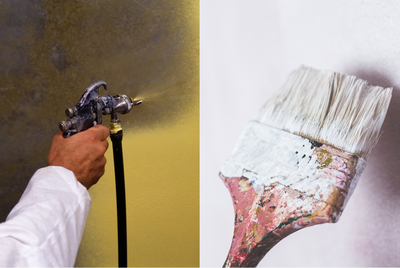
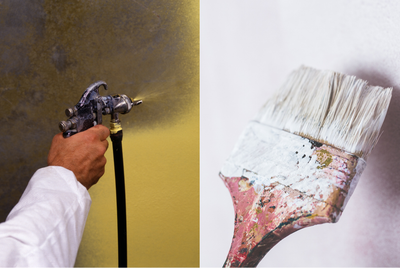
At a basic level, both tools apply coatings to a surface – but the method of application changes the outcome.
- Spray guns atomise paint into a fine, even mist, creating a uniform coating across the surface
- Paintbrushes rely on manual application, spreading paint through direct contact
This impacts finish, coverage, speed and consistency from the outset.
Finish quality
One of the most consistent findings across industry comparisons is the quality of finish.
Spray guns produce:
- Smooth, uniform coatings
- Even film thickness
- No brush marks or streaking
This is particularly important for visible surfaces, high-spec finishes and protective coatings, where consistency affects both appearance and performance.
By comparison, paintbrushes:
- Can leave visible strokes or uneven texture
- Depend heavily on operator skill
Spraying is widely recognised as the best way to achieve a “factory-like” finish quickly and consistently.
Speed and productivity
Speed is where spray guns offer one of their biggest advantages.
- Large areas can be coated quickly and evenly
- Application time is significantly reduced compared to brushing
- Less physical effort is required over long periods
Spraying is consistently identified as the faster method, particularly for large or repetitive work.
Paintbrushes, on the other hand:
- Are slower and more labour-intensive
- Require more time to achieve consistent coverage
For contractors and production environments, this difference directly impacts project timelines and labour costs.
Material efficiency
Material efficiency is often where comparisons become more nuanced.
It’s true that:
- Spray guns can use 25–33% more paint in some cases due to overspray
- Some systems may use even more if not optimised
However, this doesn’t tell the full story.
When set up correctly:
- Modern spray systems improve transfer efficiency
- Faster application reduces labour costs
- More consistent coverage reduces rework
Over the course of a project, these factors often outweigh the additional material use, making spraying the more cost-effective option overall.
Surface coverage and complexity
Spray guns are significantly more versatile across different surface types.
They perform best on:
- Large flat surfaces
- Complex geometries
- Fabricated components and machinery
- Hard-to-reach or irregular areas
The atomised spray allows paint to reach areas that brushes simply can’t cover evenly.
Paintbrushes are more limited:
- Better suited to edges, corners and small sections
- Struggle to maintain consistency across large or detailed surfaces
This is why spraying is commonly used in industrial, automotive and manufacturing environments.
Project size and application
Project size plays a major role in deciding the right method.
Spray guns are ideal for:
- Large-scale projects
- Commercial and industrial applications
- Production environments
- Time-sensitive work
Paintbrushes are typically limited to:
- Small DIY jobs
- Maintenance and touch-ups
- Low-volume applications
As project size increases, the benefits of spraying become more pronounced
Consistency and repeatability
In professional settings, consistency is critical.
Spray guns provide:
- Repeatable, controlled application
- Even coating thickness across multiple components
- Reliable results regardless of scale
Paintbrushes depend more on individual technique, making consistent results harder to achieve across larger projects.
Setup and skill
Spraying does require:
- More preparation (masking, setup)
- Equipment knowledge (pressure, nozzle selection)
- Proper ventilation and safety measures
However, once set up:
- Application is significantly faster
- Results are more consistent
Brushing is easier to start with, but far less efficient as project demands increase.
When does a paintbrush still make sense?
While spray guns are the preferred option for most applications, paintbrushes still have a role.
They are useful for:
- Edges and detailing
- Touch-ups and repairs
- Tight or confined areas
- Small, low-prep jobs
In many cases, a brush is used alongside spraying rather than instead of it.
The best approach: Spray first, brush where needed
For most projects, the most effective method is a combination of both:
- Spray gun for main surfaces, speed and finish quality
- Paintbrush for detail work and finishing touches
This approach maximises efficiency while maintaining precision where it’s needed.
Why spray guns are the preferred choice
Across most applications, spray guns offer clear advantages:
- Faster application and reduced labour time
- Smoother, higher-quality finishes
- Better coverage across large and complex surfaces
- Greater consistency and repeatability
While brushes remain useful for specific tasks, spraying is the more scalable and professional solution for modern coating applications.
Choosing the right equipment
Getting the best results from spraying depends on selecting the right equipment, setup and technique.
Factors such as nozzle size, pressure, coating type and environment all play a role in performance and efficiency.
Want to get the best results from your setup? Speak to our team for practical advice tailored to your application.