1st Apr 2026
Surface preparation is critical before any coating process. Even the highest-quality coating will fail if it is applied to a poorly prepared surface. Contamination, incorrect abrasive choice, and inconsistent blasting techniques are among the most common causes of premature coating breakdown, poor adhesion, and costly rework.
This guide explores the most frequent surface preparation mistakes and explains how to prevent them, helping contractors achieve consistent, long-lasting coating performance.
1. Inadequate cleaning before blasting
One of the most common surface preparation mistakes is blasting over oil, grease, salts, or other contaminants. Instead of removing them, blasting can drive these substances deeper into the surface profile, where they remain trapped beneath the coating film. This can lead to blistering, poor adhesion, and early coating failure.
How to avoid it:
- Degrease surfaces before blasting using approved solvents or alkaline cleaners
- Remove soluble salts with fresh water washing or salt-removal solutions
- Ensure surfaces are fully dry before abrasive blasting begins
Effective cleaning ensures contaminants are removed rather than redistributed.
2. Choosing the wrong abrasive
Not all abrasives are suitable for every substrate or coating specification. Abrasives that are too aggressive can damage the surface or create excessive profile depth, while overly fine abrasives may fail to remove mill scale or corrosion effectively. Poor abrasive selection is a leading cause of inconsistent finishes and coating adhesion issues.
How to avoid it:
- Match abrasive type and size to the substrate and coating system
- Consider hardness, friability, recyclability, and dust generation
- Use lighter media for delicate substrates and harder abrasives for heavy corrosion
Correct abrasive selection produces a consistent surface profile and improves coating performance.
3. Incorrect blasting pressure
Air pressure plays a critical role in surface preparation quality. Excessive pressure can break down abrasive too quickly and produce an uneven or overly aggressive profile. Insufficient pressure may fail to remove contamination or old coatings fully, leaving behind residues that compromise adhesion.
How to avoid it:
- Set blasting pressure according to abrasive type and job specification
- Measure pressure at the nozzle rather than only at the compressor
- Adjust pressure if abrasive consumption increases or surface finish becomes inconsistent
Stable pressure supports predictable cleaning results and uniform surface texture.
4. Poor nozzle technique and angle
Incorrect nozzle angle or inconsistent distance from the surface can lead to patchy cleaning, polished areas, and uneven profile formation. Operators may unintentionally embed contaminants or fail to fully remove corrosion, particularly in corners, welds, and complex geometries.
How to avoid it:
- Maintain a consistent nozzle distance
- Use the correct blasting angle for the level of contamination
- Avoid dwelling too long in one area
Good technique ensures uniform cleaning and reliable surface preparation across the entire substrate.
5. Ignoring environmental conditions
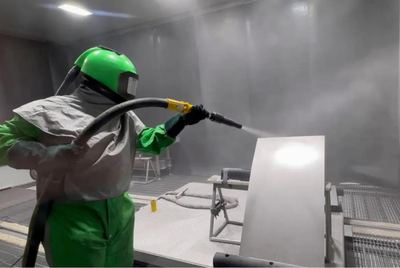
Surface preparation is not only affected by temperature and humidity, but also by the condition of the blasting environment itself. Poor ventilation, high dust levels, and moisture build-up inside blast rooms or blast booths can allow contaminants to settle back onto freshly prepared surfaces.
Moisture carried through compressed air systems can also condense inside enclosed blasting areas, increasing the risk of flash rust and surface contamination before coating is applied.
Uncontrolled blasting environments are a common cause of coating adhesion problems, even when blasting technique is otherwise correct.
How to avoid it:
- Ensure blast rooms and blast booths are properly ventilated to remove dust and spent abrasive
- Control moisture in compressed air systems using aftercoolers and air dryers
- Monitor conditions inside the blasting area, including humidity and surface temperature
- Keep prepared surfaces protected from dust and condensation before coating
Effective surface preparation depends not only on blasting technique, but on maintaining clean, controlled blasting environments.
6. Leaving surfaces exposed for too long
Even when blasting is carried out correctly, freshly prepared surfaces are highly vulnerable. Oxidation, airborne contamination, and moisture can rapidly degrade the surface profile if coating is delayed. This is a subtle but common surface preparation mistake that can undo otherwise good work.
How to avoid it:
- Apply coatings as soon as possible after blasting
- Cover or protect surfaces if coating must be delayed
- Re-clean or re-blast surfaces if contamination occurs
Timing is critical to coating durability.
7. Inadequate inspection and testing
Skipping inspection steps can allow preparation defects to go unnoticed until coating failure occurs. Visual checks alone may not reveal contamination, insufficient profile depth, or embedded residues.
How to avoid it:
- Confirm surface profile meets the specified requirement
- Check for remaining contamination or uneven cleaning
- Rework any areas that do not meet the preparation standard before coating
Inspection verifies that preparation meets specification before coating begins.
Avoiding surface preparation mistakes starts with process control
Most surface preparation failures result from a combination of small errors rather than a single major fault. Poor cleaning, incorrect abrasive choice, uncontrolled air supply, and environmental exposure all increase the risk of coating failure.
By focusing on:
- Proper cleaning
- Correct abrasive selection
- Controlled blasting pressure
- Consistent operator technique
- Environmental monitoring
- Timely coating application
- Routine inspection
Contractors can significantly reduce surface preparation failures and improve coating performance.
At Airblast Eurospray, we work with contractors across a wide range of industries to support reliable surface preparation through equipment, abrasives, and technical guidance. Understanding where mistakes commonly occur is the first step towards preventing them. Good surface preparation is not just about removing corrosion – it is about creating the right foundation for coatings to perform as intended.